
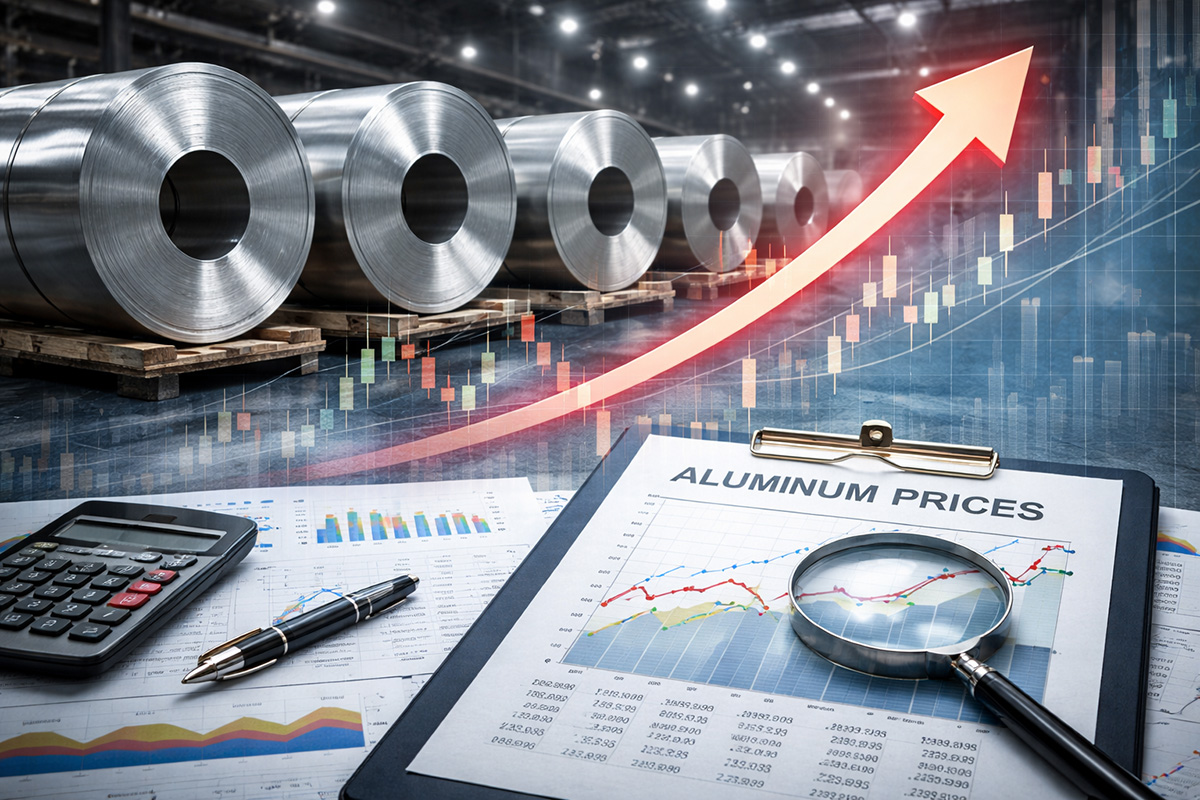
Aluminum Price Trends 2026: What’s Driving Costs?
If you’re sourcing aluminum in 2026, you’ve likely noticed something alarming: prices are behaving in ways that defy traditional market logic. While global supply forecasts point to surplus conditions, your delivered costs have surged. The culprit isn’t just the London Metal Exchange (LME) base price—it’s the Midwest Premium (MWP) that’s rewriting the rulebook.
For purchasing agents, R&D teams, and manufacturers across industries from aerospace to electronics, understanding how these two pricing pillars interact has become essential to maintaining margins and securing reliable supply. Let’s break down the forces reshaping aluminum pricing in 2026 and what your business can do about it.
The Two Pillars of Your Price: LME vs. Midwest Premium
When you receive a quote for aluminum, you’re actually looking at two distinct cost components working in tandem. The London Metal Exchange (LME) provides the global benchmark price—essentially the baseline commodity value of aluminum traded worldwide. Think of it as the “wholesale” starting point recognized across international markets.
But here’s what catches many buyers off guard: the LME price alone tells you almost nothing about what you’ll actually pay for delivered aluminum in the United States.
That’s where the Midwest Premium (MWP) comes in. This regional adjustment accounts for transportation costs, local supply-demand dynamics, import duties, and the logistical realities of getting physical metal to your facility. Historically, the MWP represented 10-15% of the total delivered cost—a predictable add-on that purchasing teams could easily factor into budgets.
In 2026, that relationship has fundamentally changed. The MWP has surpassed $1.00 per pound for the first time in history, transforming from a modest surcharge into a dominant cost driver. While the LME is forecasted to average around $2,945 per metric ton for the year, the explosive growth in the Midwest Premium means your actual delivered price is being determined more by regional factors than global commodity trends.

Understanding the 2026 price structure: The total delivered cost of aluminum is now heavily influenced by the record-high Midwest Premium alongside the LME base rate.
This decoupling has created a strategic challenge: businesses can no longer simply track LME futures and assume they understand their aluminum costs. The premium—once an afterthought—now demands as much attention as the base metal price itself.
Why 2026 is Different: The Drivers of Record Highs
Several converging factors have created the perfect storm pushing aluminum premiums to unprecedented levels.
The Tariff Tsunami
The most immediate impact comes from trade policy. The implementation of 50% tariffs on aluminum imports has fundamentally altered the cost-benefit calculation for bringing metal into the United States. What was once a viable arbitrage opportunity—sourcing cheaper international aluminum—has become prohibitively expensive for many applications.
The data tells the story: US aluminum imports have dropped approximately 25% as buyers scramble to find domestic alternatives or absorb the punishing tariff costs. This sudden contraction in available supply has created intense competition for the remaining material, driving the MWP to record levels.
Geopolitical Energy Shocks
Beyond tariffs, global instability is creating ripple effects throughout the aluminum supply chain. Ongoing tensions affecting the Strait of Hormuz have disrupted energy markets, and aluminum smelting is one of the most energy-intensive industrial processes in existence. When energy costs spike—particularly in key production regions—those costs flow directly into metal pricing.
Industry analysts have described current spot market conditions as approaching “Armageddon” scenarios, where buyers without locked-in contracts face extreme volatility and limited material availability.
The Domestic Supply Squeeze
While global markets may show theoretical surplus, the US market is experiencing the opposite: tight spot supply, extended lead times, and mills prioritizing large, multi-year contract customers over smaller or specialized orders. The large producers who traditionally supplied flexible buyers have pivoted entirely toward major accounts, leaving a significant gap in the market for specialized applications and R&D needs.

Tariffs and geopolitical instability have fundamentally shifted the cost-benefit analysis toward domestic sourcing as import costs soar under the new 50% tariff regime.
What This Means for Your Business
The margin squeeze is real. If your business operates on fixed-price contracts with customers but faces floating aluminum costs from suppliers, you’re caught in a profitability vise. Even companies with price-adjustment clauses are finding that the velocity and magnitude of MWP increases are outpacing their ability to pass costs through.
The Planning Challenge
Traditional procurement strategies built on quarterly price reviews and spot market purchases are failing. The volatility isn’t just inconvenient—it’s making accurate cost forecasting nearly impossible. R&D teams developing new products can’t establish reliable should-cost models when the premium component swings dramatically month to month.
For purchasing agents, the pressure is mounting to secure supply at predictable costs while maintaining the flexibility to respond to design changes and volume fluctuations. It’s a contradictory set of demands that the traditional aluminum supply chain—built around massive MOQs and rigid contract terms—simply can’t accommodate.
The Hidden Costs of Uncertainty
Beyond the raw material price, uncertainty itself carries costs. Engineering teams delay product launches. Finance departments build in excessive safety margins. Operations teams maintain larger inventories to buffer against supply disruptions. All of these defensive measures eat into profitability and competitive positioning.
Strategic Procurement: How to Stay Ahead
Businesses that are successfully navigating 2026’s aluminum market volatility share several common strategies:
Embrace Hybrid Sourcing Models
The days of single-source supply chains are over. Smart procurement teams are building diversified supplier networks that combine long-term contracts for baseline volumes with flexible domestic partners for specialized needs and demand variability. This approach provides both stability and agility.
Prioritize Domestic Supply Chains
With import tariffs fundamentally changing the economics, the advantage has shifted decisively toward domestic sourcing. Beyond avoiding tariff costs, domestic suppliers offer shorter lead times, reduced transportation risk, and greater responsiveness. For industries requiring precision specifications like automotive or aerospace, the quality consistency of domestic material provides additional value.
Focus on Partnership Over Pure Price
When MWP volatility can swing costs by 20-30%, saving a few pennies per pound through aggressive negotiation becomes meaningless. Instead, the value lies in finding suppliers who can provide reliable allocation, flexible order quantities, and genuine technical support. The partner who can solve your supply problem is worth far more than the vendor who simply offers the lowest quote on a spreadsheet.
Inventory Management vs. Spot Buying
While carrying inventory has costs, so does scrambling for spot material in a tight market. Businesses are finding that modestly increased inventory levels—particularly of high-use specifications—provide both cost protection and operational stability. The key is strategic selectivity: inventory critical materials while maintaining flexibility on others.
The All Foils Advantage: Agility in a Rigid Market
This is where All Foils has built its value proposition: solving the problems that large mills won’t address and importers can’t navigate in the current tariff environment.
The MOQ Problem
Major mills operate on massive minimum order quantities that work for high-volume manufacturers but fail everyone else. If you need aluminum rolls for product development, specialized battery applications, or short-run production, you shouldn’t be forced to buy six months of inventory or wait in queue behind Fortune 500 accounts.
All Foils has built its business around flexible order quantities that make economic sense for R&D teams, small manufacturers, and specialized applications. You can order what you need, when you need it, without the capital tie-up and obsolescence risk of massive minimum buys.
Domestic Reliability
With our domestic operations and expertise in slitting, coating, and laminating services, we’ve eliminated the import uncertainty that’s plaguing the 2026 market. No tariff surprises. No Hormuz-related shipping delays. No customs complications. Just reliable delivery of quality material processed to your exact specifications.
Technical Partnership
Perhaps most importantly, we bring technical expertise to support your specific application needs. Whether you’re developing insulation solutions, flexible packaging, or electronics components, our team understands the material properties and processing requirements that make the difference between a product that works and one that fails.

All Foils provides a strategic buffer against market rigidity by offering low MOQs and domestic reliability that large mills and international importers cannot match.
Looking Forward: Preparation Over Prediction
No one can predict exactly where LME prices or the Midwest Premium will land six months from now. The variables—from geopolitical events to trade policy shifts—are simply too numerous and unpredictable. But you can control how prepared your business is to handle volatility.
The companies thriving in this environment aren’t necessarily the ones with the best price forecasts. They’re the ones with flexible supply chains, strong supplier relationships, and the agility to respond when conditions change. They’ve accepted that volatility is the new normal and built their procurement strategies accordingly.
At All Foils, we’ve designed our entire operation around supporting that agility. Whether you need aluminum sheets for prototyping, custom coating services for specialized applications, or reliable supply allocation for ongoing production, we’re positioned to be your partner through whatever the market delivers.
The aluminum market of 2026 doesn’t reward passive purchasing strategies or rigid supply relationships. It rewards businesses that understand the fundamental drivers of LME and MWP pricing, maintain diverse supplier networks, and partner with vendors who prioritize service and flexibility over pure volume.
Ready to discuss how All Foils can support your specific aluminum needs in today’s challenging market? Contact our team to explore how domestic sourcing and flexible order quantities can provide the stability and responsiveness your operations require. Or explore our complete product catalog to see the full range of materials and services we offer.