
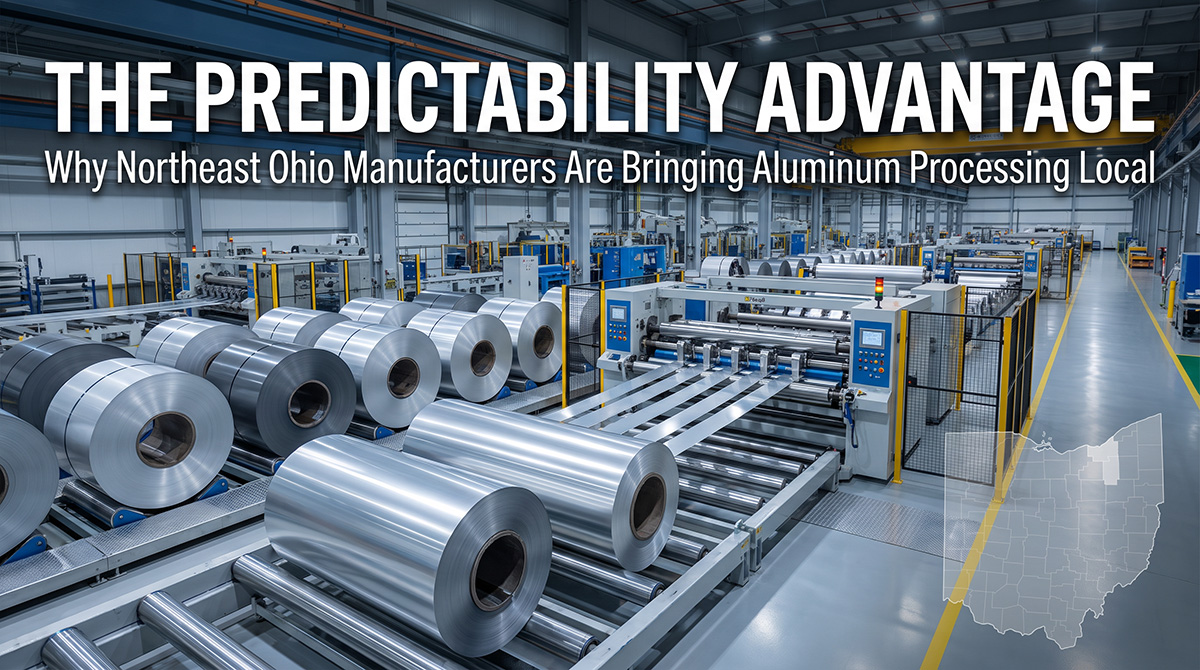
Ohio Manufacturers Seize the Aluminum Edge
The aluminum procurement landscape has fundamentally changed. For decades, manufacturers could play global suppliers against each other, chasing the lowest per-ton price regardless of origin. That playbook is dead. Between tariff volatility swinging 25-50%, extended lead times stretching past twelve weeks, and freight damage eating into savings, the “lowest cost” strategy has become the highest risk.
The new competitive advantage isn’t finding cheaper aluminum—it’s finding predictable aluminum. And increasingly, Northeast Ohio manufacturers are discovering that domestic aluminum is now structurally more expensive and less predictable to import, so a Northeast Ohio processor that can slit, coat, and laminate in-house solves both the cost-volatility problem and the custom-spec problem in one relationship.

Hedge against global supply chain volatility by partnering with a domestic processor that offers short lead times and reduces freight costs for regional manufacturers.
The New Reality of Aluminum Procurement
Three structural shifts have permanently altered how manufacturers should source aluminum:
Tariff Uncertainty as the New Normal As of late 2025, U.S. aluminum foil prices have stabilized at higher levels than historical averages—but “stabilized” doesn’t mean predictable when you’re importing. Section 232 tariffs can adjust quarterly, and any given shipment might face additional duties that weren’t priced into your PO three months earlier. Purchasing agents who once built budgets around global spot prices now face CFOs demanding explanations for 15-20% variance between quote and invoice.
The Hidden Costs of Long Lead Times A twelve-week lead time isn’t just an inconvenience—it’s a working capital trap. You’re financing inventory that’s floating somewhere in the Pacific, unable to respond to customer spec changes, and praying the shipment clears customs without issues. For just-in-time manufacturers in automotive and aerospace sectors, this lack of agility translates directly into lost contracts.
Quality Control You Can’t Inspect Until It Arrives When you buy from overseas mills, you’re accepting whatever tolerance variations survived the ocean crossing. Coil damage, width inconsistencies, and surface defects only become apparent when your production line starts rejecting parts. With an integrated Northeast Ohio processor performing slitting, coating, and laminating domestically, quality issues get caught before material leaves the building—not after it shuts down your line.
The Advantage of the “All-In-One” Northeast Ohio Processor
The strategic value of an integrated domestic processor isn’t just proximity—it’s the compression of your supply chain from multiple vendors and processes into a single, accountable relationship. Here’s what that consolidation delivers:

Our integrated 150,000-square-foot facility in Northeast Ohio streamlines production by housing slitting, coating, and laminating under one roof for maximum efficiency.
In-House Precision Slitting
Master coils arrive in standard widths that rarely match your production specifications. A 150,000-square-foot facility equipped with precision slitting equipment transforms those master coils into the exact widths your automated lines require—down to tolerances that prevent edge damage and feeding errors. This isn’t just cutting metal; it’s engineering material that runs cleanly through high-speed production without operator intervention.
For HVAC manufacturers running fin-forming equipment at 400 feet per minute, width variance of even 0.010″ causes jams. When your supplier controls the slitting process in-house, they can dial in those tolerances and verify them before shipment—not leave you discovering the problem three shifts into a production run.
Custom Coating Capabilities
Generic mill-finish aluminum serves commodity applications. Everything else—heat-seal layers for food packaging, corrosion-resistant coatings for marine environments, decorative finishes for architectural panels—requires post-processing that most mills won’t touch at reasonable volumes.
A Northeast Ohio processor with in-house coating capabilities bridges this gap. Need an epoxy coating for chemical resistance? A heat-activated adhesive layer for laminated applications? Specialty lacquers for HVAC applications? Instead of coordinating between a mill, a coater, and a distributor—each adding lead time and handling risk—you specify the final product and receive material ready for your production process.
Integrated Laminating Services
Advanced applications increasingly require composite materials: aluminum foil bonded to paper for moisture barriers, foil laminated to films for flexible packaging, or multi-layer constructions for thermal insulation. When your processor handles laminating in the same facility that performs slitting and coating, you eliminate two entire handoffs in your supply chain.
More importantly, you gain a partner who understands how each process affects the next. The coating chemistry must be compatible with the laminating adhesive. The slitting tolerances must account for the composite material’s different handling characteristics. An integrated processor manages these interdependencies as a single engineering problem, not as separate vendor coordination nightmares.
Solving the Spec Problem: From R&D to Full Production
Here’s the procurement trap that kills innovation: Global mills require 10,000-pound minimums. Your R&D team needs 500 pounds to validate a new product design. Most distributors stock standard alloys in standard gauges—which means your engineers either compromise their design to match available material, or they abandon domestic sourcing entirely and accept the import delays.
A Northeast Ohio processor with extensive inventory and low minimum order capabilities changes this equation fundamentally.

Eliminate the barrier of high minimum order quantities. We support R&D and prototyping with small-run flexibility that international mills cannot provide.
Supporting the Complete Development Cycle
Engineers and students exploring aluminum foil applications need actual material to test, not just data sheets. A supplier that stocks alloys from the 1000 series through 8000 series—and will sell small quantities for prototyping—becomes a strategic R&D partner, not just a vendor.
This flexibility accelerates time-to-market dramatically. Your team can test three different alloy/coating combinations in parallel, validate the winner, and scale directly to production volumes with the same supplier who supported your prototype work. No re-sourcing. No qualification delays. No surprise specification changes because your prototype material came from a different mill than your production material.
The Bridge from Prototype to Production
Most purchasing departments maintain strict vendor separation between R&D suppliers (who handle small, expensive orders) and production suppliers (who demand volume commitments). This creates a dangerous handoff where specifications that worked perfectly in prototype can fail mysteriously in production—simply because different source material behaves differently despite meeting the same nominal specifications.
When a single processor with low minimums and high-volume capacity supports both phases, you eliminate this risk. The 5052-H32 sheet your engineers validated is identical to the 5052-H32 in your production runs, because it came from the same master coils, processed on the same equipment, to the same internal specifications. This continuity is worth significantly more than theoretical per-pound savings from playing vendors against each other.
Domestic Security: ISO 9001 and Quality Assurance
Price predictability and short lead times matter little if the material doesn’t consistently meet specifications. This is where the ISO 9001:2015 certification of an established Northeast Ohio facility becomes more than a checkbox—it’s your hedge against the quality variability that plagues global sourcing.

With over 45 years of experience, we provide specialized aluminum foil and sheet solutions tailored for the rigorous demands of the aerospace and automotive sectors.
What 45 Years of Experience Delivers
A processor with forty-five years serving Northeast Ohio manufacturers has seen every failure mode, solved every edge case, and refined processes through thousands of customer applications. That institutional knowledge doesn’t exist in a commoditized global supply chain where you’re communicating through importers and trading companies.
When an aerospace manufacturer needs 5052 aluminum for structural components, they’re not just buying an alloy specification—they’re buying the supplier’s understanding of how that alloy behaves under forming operations, what surface treatments are compatible, and how to maintain traceability through their documented quality compliance systems.
Industry-Specific Expertise That Matters
Generic aluminum distributors stock material. Specialized processors understand applications:
- Aerospace and Aircraft: The differences between 2024, 5052, and 7075 alloys aren’t just data sheet properties—they’re real-world tradeoffs in formability, corrosion resistance, and weldability that experienced processors help engineers navigate.
- Automotive Applications: Heat shield requirements for electric vehicle battery packs differ fundamentally from traditional exhaust components. A processor serving the automotive sector understands these evolving specifications and maintains relevant material inventories.
- HVAC and Building Construction: Fin stock for heat exchangers demands specific temper conditions and surface treatments that affect thermal transfer efficiency. Processors specializing in HVAC films and lacquers engineer coatings specifically for these performance requirements.
- Food and Beverage Packaging: Barrier properties, heat-seal characteristics, and FDA compliance aren’t afterthoughts—they’re fundamental design parameters that specialized coating capabilities address from material selection through final processing.
The Rejection Rate That Defines Real Quality
Marketing materials claim quality. Rejection rates prove it. When a processor maintains rejection rates below 0.5% across diverse customer applications—from precision electronics to high-volume food packaging—you’re seeing the result of process control that simply can’t exist when you’re sourcing from multiple suppliers and hoping compatibility works out.
Simplifying Your Supply Chain: The Strategic Relationship
Strip away the technical specifications and processing capabilities, and the core value proposition becomes clear: consolidating vendors eliminates the coordination overhead that consumes purchasing departments and creates failure points.
When material procurement required three vendors—a mill for base stock, a converter for processing, a distributor for logistics—you needed three quality systems, three sets of documentation, three points of failure, and three negotiations every time market conditions shifted. More critically, when something went wrong, you faced three-way finger-pointing about whether the problem originated with base material, processing, or handling.
An integrated Northeast Ohio processor with comprehensive services—from maintaining master coil inventory through precision slitting, custom coating, specialized laminating, and direct shipping—converts that three-vendor complexity into a single accountable relationship. One quality system. One documentation package. One phone call when you need to modify specifications or accelerate delivery.
The Working Capital Advantage
Beyond the operational simplicity, domestic processing fundamentally changes your working capital requirements. Instead of financing twelve weeks of ocean freight and customs clearance, you’re supporting 2-5 day lead times. That capital efficiency compounds across your entire materials budget—money that was trapped in transit can now respond to actual market opportunities rather than theoretical demand forecasts made three months prior.
Building for Long-Term Partnership
Suppliers that support your R&D, scale with your production, and maintain consistent quality through market volatility aren’t transactions—they’re strategic relationships. A processor with a proven track record serving Northeast Ohio manufacturers understands this distinction. They invest in inventory positions that support your just-in-time requirements. They maintain processing capacity for your peak demand periods. They document their quality systems and certifications to support your customer audits.
This isn’t the lowest per-pound cost—it’s the lowest total cost of ownership when you factor in carrying costs, quality risks, engineering time, and opportunity costs of delayed market entry.
The aluminum procurement landscape has permanently shifted from commodity pricing to supply chain reliability. Northeast Ohio manufacturers who recognize this shift early—and partner with integrated processors capable of delivering domestic predictability along with technical expertise—gain competitive advantages that global sourcing simply cannot match.
For aerospace and automotive manufacturers that bet their reputations on consistent quality, for HVAC companies managing seasonal demand spikes, for food packaging operations that can’t tolerate line shutdowns, the question isn’t whether domestic processing costs more per pound. The question is whether you can afford the volatility, delays, and quality risks of continuing to source aluminum the old way.
Stop chasing global imports. Explore how an integrated Northeast Ohio aluminum solutions provider can transform your supply chain from a cost center into a competitive advantage.