
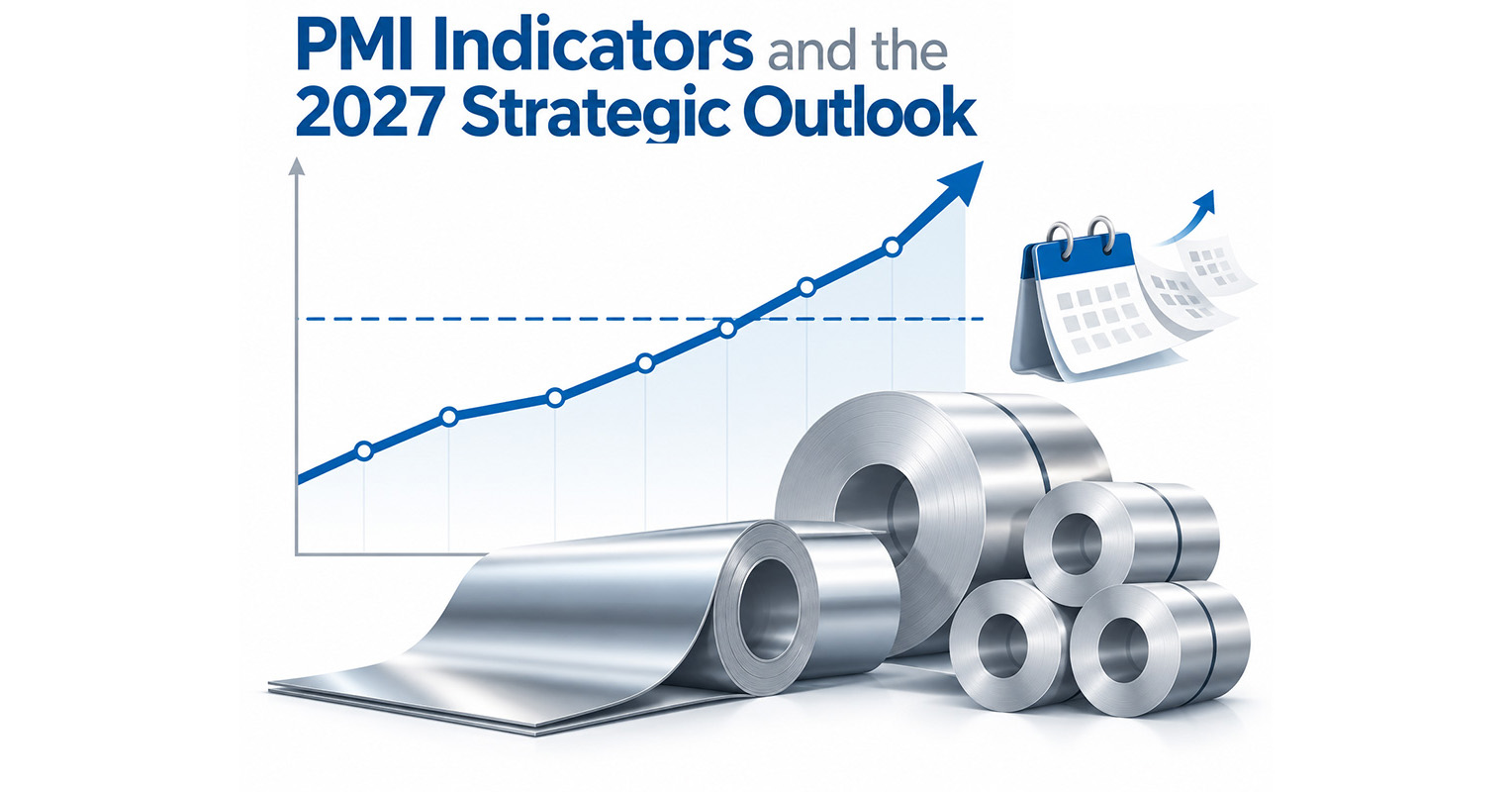
Navigating the Aluminum Market: PMI Indicators and the 2027 Strategic Outlook
For purchasing agents, SMB owners and R&D engineers, 2026 has been a year of reckoning. After 32 consecutive months of price hikes, the aluminum market reached a breaking point that forced procurement teams to rethink everything from supplier relationships to order sizing. Now, as we look toward 2027, a new question dominates strategic planning: is this the rebound year that finally brings relief or simply a new phase of structural scarcity?
The answer lies in a tool that savvy buyers have learned to watch closely — the Manufacturing Purchasing Managers’ Index (PMI). Combined with tariff realities and shifting demand from EV and AI infrastructure sectors, the PMI has become the critical early warning system for anyone sourcing aluminum products in today’s volatile climate.
The Current Landscape: A 2026 Retrospective
To understand where the market is headed, it helps to understand how it got here. The 32-month price hike streak that defined 2025 and much of 2026 wasn’t driven by a single factor — it was a convergence of pressures. Middle East conflicts disrupted global smelting capacity and energy supply chains that feed primary aluminum production. Simultaneously, demand from electric vehicle manufacturers and data center builders surged far faster than new smelting capacity could come online.
Add to this the persistence of Section 232 tariffs — which remain locked at 50% on raw aluminum imports as of late 2026 — and you have a market where traditional “buy it cheap overseas” strategies have essentially collapsed for small and mid-sized buyers. Lead times, meanwhile, have stretched beyond even pandemic-era extremes, leaving purchasing agents with less room for error and far less patience for guesswork.
This is precisely why forward-looking indicators like the PMI have become indispensable.
Decoding the PMI: The Buyer’s Early Warning System
The Manufacturing PMI is a monthly survey of purchasing managers that measures the health of the manufacturing sector based on new orders, production, employment, supplier deliveries, and inventories. A reading above 50.0 signals expansion; below 50.0 signals contraction. For aluminum buyers specifically, the threshold that matters most is 55.0 — historically, PMI readings above this level have correlated with aluminum price increases materializing 3 to 5 months later.
Why does this lag exist? When manufacturing activity expands, demand for industrial inputs — including aluminum sheet, coil, and specialty alloys — increases before that demand shows up in spot market pricing. Mills and distributors adjust allocations and pricing with a delay, which means a sharp PMI reading today is effectively a preview of your Q2 2027 invoice.

Understanding the PMI as a leading indicator allows purchasing agents to forecast aluminum price shifts and time their 2027 inventory buys more effectively.
Actionable tip for purchasing agents: Don’t just glance at the headline PMI number — read the respondent comments buried in the monthly report. These qualitative notes from actual purchasing managers often flag specific material shortages, supplier delays, or demand spikes months before they hit broader commodity indices. Pairing PMI trend-watching with a review of current market dynamics gives procurement teams a genuine head start on Q1 and Q2 2027 buying decisions, rather than reacting to price increases after they’ve already hit the invoice.
The 2027 Forecast: Growth vs. Scarcity
Industry forecasters are converging on a consistent narrative: 2027 is shaping up to be a “Rebound Year.” After a largely stagnant 2026, global metals output is projected to grow by 4.0%, with global industrial production expected to climb 4.1% — a meaningful acceleration that will reshape demand patterns across every downstream sector.
Two forces are driving this rebound disproportionately:
The AI and data center boom. Hyperscale data centers require enormous volumes of aluminum for chassis, cooling infrastructure, and networking hardware. As AI infrastructure buildouts accelerate globally, this segment alone is absorbing capacity that would otherwise flow to traditional industrial buyers.
The EV lightweighting push. Electric vehicle manufacturers continue to prioritize aluminum over steel for battery enclosures, body panels, and structural components to offset battery weight. This has elevated specific alloys — particularly 5083 and 6061 — to near-premium status. These grades, prized for their strength-to-weight ratio and corrosion resistance, are increasingly treated as the “green metal” of choice for EV and marine applications, and allocation toward these sectors is tightening supply for standard industrial and commercial buyers.

The 2027 outlook projects a significant recovery in global metals output, driven primarily by the rapid expansion of EV infrastructure and AI data center cooling requirements.
The practical implication: even as overall supply grows, the type of aluminum in highest demand is shifting. Buyers who need standard sheet, coil, or rolled products for traditional applications in electronics, HVAC, or automotive manufacturing may find themselves competing for mill capacity against higher-margin EV and data center contracts.
The Small Buyer Crisis: Navigating Tariffs and MOQs
Here’s where the 2027 outlook becomes genuinely difficult for smaller operations. With Section 232 tariffs holding firm at 50% on raw aluminum imports, and Red Sea shipping disruptions continuing to add cost and uncertainty to international freight, the “cheap imports” playbook that sustained many SMBs for years is no longer viable. The math simply doesn’t work when a 50% customs value hike is layered on top of already-elevated base commodity prices.
Compounding this is what can only be described as “mill greed” — large-scale producers, flush with high-volume, high-margin contracts from EV and AI customers, have little incentive to prioritize smaller accounts. Minimum Order Quantities have crept upward, and traditional distributors increasingly decline to service the 1-unit prototype runs or 10-unit specialty orders that R&D teams and small manufacturers depend on.
 Domestic sourcing has transitioned from a preference to a strategic necessity as 50% tariffs and global shipping disruptions make traditional import models unsustainable for SMBs.
| PMI Reading | Market Signal | Typical Price Impact (3-5 Month Lag) |
|---|---|---|
| Below 50.0 | Contraction | Softening or stable pricing |
| 50.0 – 54.9 | Modest expansion | Gradual upward pressure |
| 55.0+ | Strong expansion | Significant price hikes likely |
This dynamic has made domestic sourcing less a matter of patriotism and more a matter of operational survival. Working with a vertically integrated domestic supplier — one offering slitting, sheeting, and toll processing services alongside raw material supply — insulates buyers from both tariff exposure and the shipping chaos plaguing import routes.
Sourcing Strategies for 2027
For purchasing agents: Build PMI monitoring into your monthly procurement rhythm. Use readings above 55.0 as a trigger to accelerate Q1 and Q2 2027 purchasing before anticipated price lags materialize. Simultaneously, audit lead times with current suppliers — if they exceed pandemic-era benchmarks, it’s time to diversify.
For R&D teams and graduate students: Minimum Order Quantities shouldn’t be a barrier to innovation. Seek out suppliers who explicitly support low-volume prototype runs across specialty alloys and adhesive-backed aluminum products — these partnerships allow experimentation without the capital commitment large mills demand.
For businesses evaluating long-term contracts: The value of a vertically integrated domestic supply chain cannot be overstated heading into 2027. Reliable access to aluminum coils, sheets, and rolls — without the volatility of tariff-exposed imports — provides the pricing stability needed to plan multi-quarter production schedules with confidence.
2027 Aluminum Buyer’s Prep Checklist
- Audit current suppliers for tariff exposure and lead-time reliability
- Set up monthly PMI monitoring with a 3-5 month price-impact lens
- Evaluate domestic alternatives before Q1 2027 contract renewals
- Identify low-MOQ partners for prototype and R&D needs
- Monitor energy costs tied to smelting capacity in key regions
- Pre-qualify backup suppliers for 5083 and 6061 alloy grades
The Bottom Line
2027 will bring growth — but not uniform relief. The rebound in global output will be absorbed quickly by EV and AI demand, leaving traditional buyers to navigate a market where tariffs, mill consolidation, and PMI-driven price lags all compound simultaneously. The agents and businesses who thrive will be the ones who treat the PMI as an actionable forecasting tool, not a background statistic, while building sourcing relationships that prioritize domestic reliability over short-term import savings. For a deeper look at how these dynamics affect specific product lines, explore our full range of aluminum offerings or contact our team to discuss 2027 contract planning.