
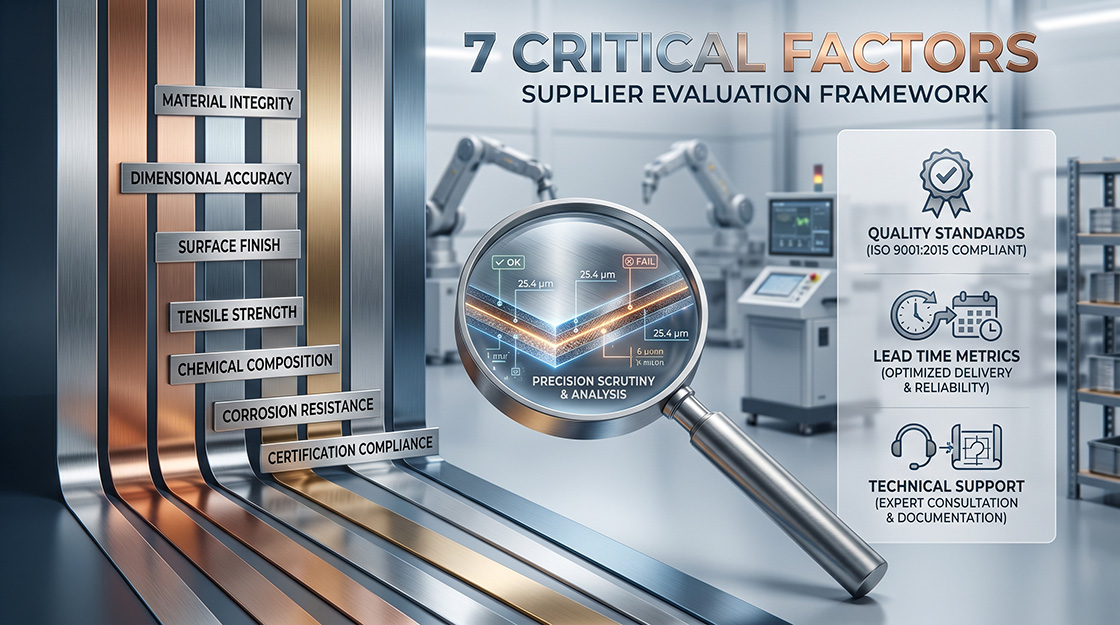
7 Proven Ways to Choose a Top-Tier Foil Supplier
In the world of metal foil, a lead time delay of one week or a thickness deviation of 5 microns can derail an entire project. Whether you are a purchasing agent for a Fortune 500 company or an R&D engineer prototyping a new medical device, selecting a supplier is more than a transaction—it’s a risk-management decision. The wrong choice can result in production delays, material waste, and compromised product performance. The right supplier becomes a strategic partner who understands your technical requirements and delivers consistent quality when you need it most.
This comprehensive framework will help procurement teams and engineers vet potential vendors across seven essential criteria to minimize supply chain risk and ensure material quality.

1. Quality Standards & Compliance: Beyond Basic Certifications
When evaluating a foil metal supplier, ISO 9001 certification is merely the starting point—not the finish line. While this standard demonstrates basic quality management systems, the most reliable suppliers go significantly further by maintaining industry-specific certifications that prove their capability to meet demanding specifications.
For aerospace and defense applications, AS9100 certification is essential. Medical device manufacturers should prioritize suppliers with FDA or BRC compliance for food-grade and pharmaceutical applications. These specialized certifications indicate that a supplier understands the critical nature of traceability and documentation in regulated industries.
Material Test Reports (MTRs) and traceability are non-negotiable elements of a quality supplier relationship. Every lot of material should come with comprehensive documentation that includes:
- Chemical composition analysis
- Mechanical property verification
- Heat lot numbers for full traceability
- Surface quality assessments
- Thickness tolerance measurements
Ask potential suppliers about their testing protocols. Do they conduct in-house testing, or do they rely solely on mill certificates? The best distributors perform additional verification testing to ensure materials meet specifications before they reach your facility. This extra layer of quality control can prevent costly production issues and material rejections.
Request sample Material Test Reports during the vetting process. These documents reveal whether a supplier truly understands metallurgical standards or simply passes along paperwork without verification. Look for detailed, specific data rather than generic certificates.
2. Minimum Order Quantity (MOQ) Flexibility: The R&D Differentiator
One of the most frustrating challenges in the metal foil industry is the gap between mill minimums and actual project needs. Traditional metal mills often require MOQs of 5,000 pounds or more—a prohibitive barrier for R&D teams, prototype development, and small-batch manufacturing runs.

This disparity has created a distinct category of specialized foil distributors who bridge the gap between research-scale needs and production-scale supply. These suppliers maintain diverse inventory specifically to serve customers who need 50 pounds, 10 pounds, or even smaller quantities for initial testing and development work.
The MOQ question should be one of your first inquiries when contacting potential suppliers. Specifically ask about:
- Minimum order quantities for different alloys and thicknesses
- Whether they maintain stock inventory or only handle custom rolling orders
- Pricing structures for small-batch vs. production-scale orders
- Lead time differences between stock and custom materials
Universities, research institutions, and product development teams particularly benefit from suppliers with flexible MOQs. The ability to order small quantities of aluminum foil for initial testing, then scale up to larger production runs with the same supplier, creates continuity in material properties and simplifies quality control.
Students and academics often face unique challenges when sourcing specialized materials for research projects. A supplier who accommodates small orders for educational purposes demonstrates a commitment to supporting innovation at every scale.
3. Lead Time Accuracy: Understanding Inventory vs. Custom Rolling
Lead time reliability directly impacts production schedules, project timelines, and inventory carrying costs. However, not all lead times are created equal, and understanding the difference between stock materials and custom rolling is crucial for accurate planning.
Stock inventory materials from a distributor who maintains warehouse inventory typically ship within 1-3 business days. These suppliers have invested in maintaining commonly-used gauges and alloys specifically to serve customers who need quick turnaround. When a supplier quotes a short lead time, verify that the material is actually in stock rather than requiring a custom mill run.
Custom rolling operations involve ordering material directly from mills, which can extend lead times to 6-12 weeks depending on mill capacity and material specifications. This timeline includes production scheduling at the mill, rolling operations, quality testing, and transportation.
During supplier evaluation, ask these critical questions about lead times:
- What percentage of quoted materials are stock vs. custom order?
- How frequently do you update inventory availability?
- What is your on-time delivery performance record?
- Do you provide real-time order tracking and status updates?
- What contingency plans exist for supply chain disruptions?
Request references from existing customers specifically about lead time accuracy. A supplier may promise aggressive timelines during the sales process but fail to deliver consistently. Past performance with similar customers provides the most reliable indicator of future reliability.
4. Technical & Metallurgical Support: More Than Just Order Taking
The complexity of metal foil selection demands more than a simple order desk—it requires genuine metallurgical expertise. The difference between alloy 1235 aluminum and 8011 aluminum, or between 304 and 316 stainless steel foil, significantly impacts performance in specific applications. A supplier who can guide these decisions adds immense value beyond commodity pricing.

Technical support should extend across the entire material selection process:
- Alloy selection based on specific application requirements
- Thickness recommendations considering formability and strength needs
- Surface finish specifications for adhesion or barrier properties
- Temper selection to achieve required mechanical properties
- Coating or laminating options to enhance performance
For battery applications, the purity level and surface characteristics of copper and aluminum foil directly affect electrochemical performance. For aerospace applications, understanding tolerance specifications and certification requirements is non-negotiable. The best suppliers employ or have access to metallurgists who can discuss these technical nuances with engineering teams.
Tolerance control represents another critical dimension of technical support. High-precision applications require foils held to tolerances of ±5% or tighter. Ask potential suppliers about their tolerance capabilities and quality control processes. Can they provide precision slitting to exact widths? Do they offer flatness guarantees for applications sensitive to material warping?
During initial conversations with potential suppliers, pose specific technical questions related to your application. The quality and depth of their responses will quickly reveal whether you’re speaking with order processors or technical partners who understand material science.
5. Inventory Depth: The Multi-Metal Advantage
Supply chain efficiency improves dramatically when you can source multiple materials from a single supplier. A distributor who stocks aluminum, copper, stainless steel, and specialty alloys reduces the complexity of vendor management, consolidates shipping costs, and simplifies quality tracking.

The multi-metal advantage delivers several practical benefits:
Simplified procurement processes: Managing relationships with one well-stocked supplier rather than three or four specialists reduces administrative overhead, streamlines purchase orders, and consolidates invoicing.
Reduced shipping costs: Combining multiple materials in single shipments minimizes freight expenses, particularly for small to medium-sized orders where shipping costs can represent a significant percentage of total material cost.
Material compatibility assurance: When developing products that incorporate multiple types of foil, sourcing all materials from one supplier who understands your complete project reduces the risk of compatibility issues between different metal types.
Consistent quality standards: A single supplier applies uniform quality control standards across all materials, providing consistency in documentation, testing protocols, and material certifications.
When evaluating suppliers, review their complete product catalog. Beyond basic aluminum and copper offerings, do they stock specialty materials like Inconel, brass, or nickel foils? The breadth of their inventory indicates their commitment to serving diverse applications and technical requirements.
For companies with complex product portfolios requiring multiple foil types, consolidating to a single-source supplier with deep inventory creates competitive advantages through reduced logistics complexity and strengthened supplier relationships.
6. Precision Processing Capabilities: Beyond Raw Material Supply
The most valuable foil suppliers don’t simply warehouse and ship master coils—they provide precision processing services that transform raw materials into production-ready formats. These value-added services can eliminate the need for in-house processing equipment and specialized labor.
Slitting services convert wide master rolls into precise widths required for specific applications. High-quality slitting operations maintain tight tolerances (±0.010″ or better), produce clean edges without burrs, and prevent material damage during processing. Poor slitting quality leads to edge defects that cause web breaks during converting operations or contamination in sensitive applications.
Sheeting capabilities allow customers to receive materials in cut-to-size formats ready for stamping, forming, or assembly operations. Precision sheeting eliminates waste from buying full rolls when only specific sizes are needed. Ask about dimensional tolerance capabilities and whether the supplier can accommodate custom sheet sizes beyond standard dimensions.
Advanced processing services that distinguish exceptional suppliers include:
- Precision spooling and core mounting to customer specifications
- Clean room processing for contamination-sensitive applications
- Custom packaging to protect materials during shipment and storage
- Surface treatments and cleaning processes to prepare materials for downstream operations
Suppliers offering coating and laminating services provide particular value for customers requiring specialized surface properties. The ability to apply adhesives, protective coatings, or combine foils with other materials in a single processing step streamlines production workflows.
During supplier evaluation, tour their processing facilities if possible. Direct observation of equipment capabilities, quality control measures, and housekeeping standards provides insights that specification sheets cannot convey. Well-maintained processing equipment and organized facilities indicate operational excellence that translates to consistent product quality.
7. Domestic Reliability: The Near-Shore Advantage
While global sourcing offers cost advantages in some scenarios, domestic suppliers provide compelling benefits that often outweigh marginal price differences—particularly for time-sensitive projects, small to medium quantities, and applications requiring close technical collaboration.
Communication efficiency improves dramatically when working with domestic suppliers in the same time zone who speak your language as their native tongue. Technical discussions about specifications, quality issues, or custom requirements proceed more smoothly without language barriers or time-delayed responses spanning multiple business days.
Faster emergency response capabilities become possible when suppliers are located within your country. When production issues arise requiring immediate material replacement or technical support, domestic suppliers can expedite shipments that arrive in days rather than weeks. This responsiveness can mean the difference between minor production disruptions and major customer delivery failures.
Regulatory compliance and material traceability are more straightforward with US-based suppliers who adhere to American manufacturing standards and maintain documentation aligned with domestic regulatory expectations. For regulated industries like medical devices, aerospace, or food packaging, the simplified compliance chain of domestic materials reduces audit complexity.
Quality control and returns are simpler to manage with nearby suppliers. If material quality issues arise, arranging returns, obtaining credit, and receiving replacement materials happens exponentially faster with domestic sources. The logistical and financial burden of international returns—including customs processes, international shipping costs, and extended timelines—often makes quality issues with overseas suppliers extremely costly to resolve.
Supporting local manufacturing ecosystems by working with domestic suppliers strengthens the broader industrial base, ensures jobs remain in your region, and builds relationships with partners who are accessible for facility visits, technical meetings, and collaborative problem-solving.
When comparing quotes from international and domestic suppliers, conduct a total cost of ownership analysis that accounts for shipping costs, lead times, inventory carrying costs, quality risk, and responsiveness rather than simply comparing per-pound pricing.
Your Supplier Evaluation Checklist
Use this rapid-vet framework during initial supplier conversations:
✅ Quality & Compliance
- Request copies of relevant certifications (ISO 9001, AS9100, industry-specific)
- Ask for sample Material Test Reports
- Inquire about in-house testing capabilities
✅ MOQ Flexibility
- Confirm minimum order quantities for your specific materials
- Understand pricing structures for different order sizes
- Verify stock availability vs. custom rolling requirements
✅ Lead Time Accuracy
- Request on-time delivery performance metrics
- Understand the difference between stock and custom lead times
- Ask for customer references regarding delivery reliability
✅ Technical Support
- Assess the depth of metallurgical expertise available
- Discuss your specific application requirements
- Evaluate the quality and specificity of technical responses
✅ Inventory Depth
- Review the complete product catalog for multi-metal availability
- Confirm stock levels for your required materials
- Assess their ability to serve as a single-source supplier
✅ Processing Capabilities
- Identify which value-added services are available
- Understand tolerance capabilities for slitting and sheeting
- Review quality standards for processing operations
✅ Domestic Reliability
- Confirm facility locations and shipping origins
- Evaluate communication responsiveness during initial contact
- Assess their understanding of domestic regulatory requirements
Making the Strategic Choice
Selecting a metal foil supplier requires balancing multiple factors—quality assurance, order flexibility, technical expertise, processing capabilities, and supply chain reliability. The optimal choice depends on your specific priorities: R&D teams may prioritize technical support and low MOQs, while production procurement may emphasize lead time consistency and processing capabilities.
The supplier who can serve as a true partner—understanding your technical requirements, accommodating your order patterns, and providing reliable delivery—creates competitive advantages that extend far beyond material costs. By systematically evaluating potential suppliers against these seven critical factors, you’ll build supply chain relationships that support both current operations and future innovation.
Ready to find a supplier who meets these critical standards? Contact our team to discuss your specific requirements or explore our complete capabilities to see how we serve customers from R&D through production scale.