
How to Choose the Right Aluminum Foil Gauge
When engineers specify materials for a lithium battery pouch, packaging specialists design a pharmaceutical blister pack, or R&D teams prototype a new heat shield, they face the same critical decision: which aluminum foil gauge will deliver the performance their application demands without over-engineering costs?
A difference of just 5 microns can mean the difference between a successful electromagnetic interference (EMI) shield and a catastrophic equipment failure. Yet the aluminum foil industry speaks in a confusing babel of measurement units—microns, mils, inches, and “gauge”—often used interchangeably, creating massive confusion for buyers trying to make precise technical decisions.
This guide cuts through that confusion. Whether you’re a purchasing agent sourcing industrial aluminum foil products for a manufacturing line, an engineer validating specifications against regulatory requirements, or a small business owner trying to understand why your current foil keeps tearing, you’ll find the expert-level clarity you need to make confident gauge selections.
Understanding Aluminum Foil Gauge: The Foundation
In the aluminum industry, “gauge” is shorthand for the decimal thickness of the material. Unlike wire gauge systems where higher numbers mean thinner material, aluminum foil thickness is typically expressed directly in microns (µm), mils (thousandths of an inch), or decimal inches.
The critical insight most buyers miss: thickness alone doesn’t determine performance. Gauge selection is actually a three-dimensional decision matrix involving:
- Thickness (Gauge/Micron) – The actual material depth
- Alloy Selection – The aluminum chemistry (1100, 1235, 8011, 8079, etc.)
- Temper – The mechanical properties from heat treatment (Dead Soft “O” to Hard “H18”)
We’ll address all three dimensions, but first, let’s establish the master reference that allows you to navigate between measurement systems with confidence.

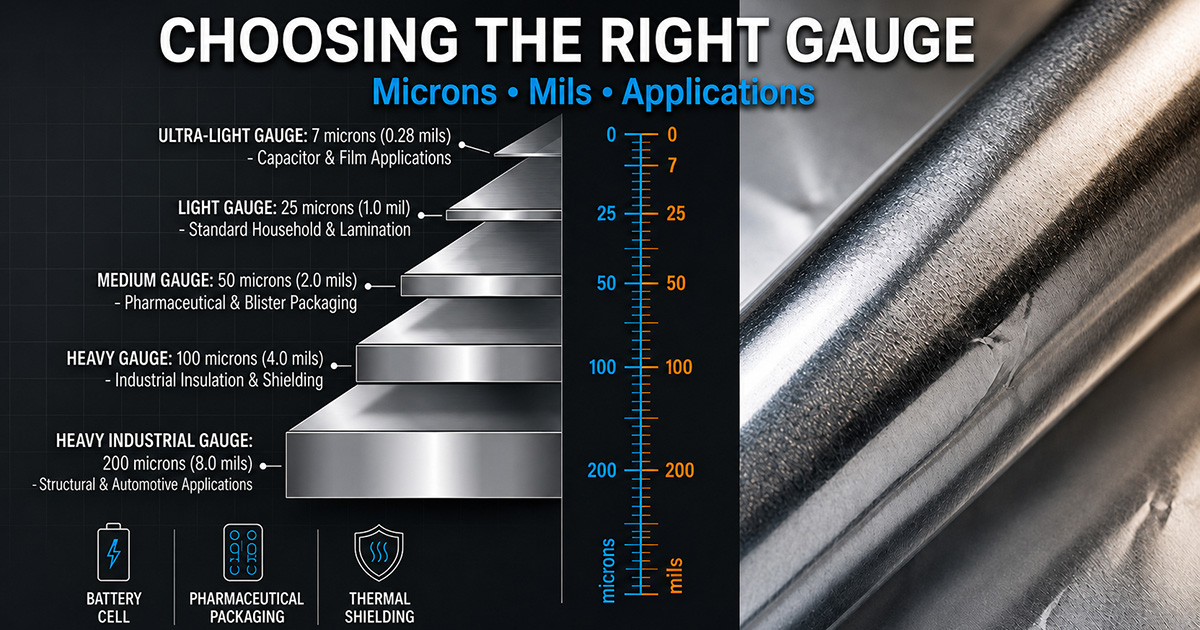
This comprehensive conversion guide simplifies the transition between industrial microns and commercial mil measurements, ensuring you select the precise thickness required for your specific technical or commercial application.
The Master Thickness Conversion Table
This is the high-authority reference most aluminum foil converters won’t provide because it demystifies their pricing tiers. Use it to translate between supplier specifications, engineering drawings, and commercial product descriptions:
| Common Classification | Microns (µm) | Inches (in) | Mils (0.001″) | Millimeters (mm) |
|---|---|---|---|---|
| Ultra-Light / Capacitor | 6.0 – 9.0 | 0.0002 – 0.00035 | 0.23 – 0.35 | 0.006 – 0.009 |
| Standard Foodservice | 10 – 16 | 0.0004 – 0.0006 | 0.40 – 0.63 | 0.010 – 0.016 |
| Heavy Duty | 18 – 24 | 0.0007 – 0.0009 | 0.70 – 0.94 | 0.018 – 0.024 |
| Industrial / Extra Heavy | 25 – 50 | 0.001 – 0.002 | 1.0 – 2.0 | 0.025 – 0.050 |
| Heavy Industrial | 100 – 200 | 0.004 – 0.008 | 4.0 – 8.0 | 0.100 – 0.200 |
Pro Tip: When reviewing international supplier quotes, convert everything to microns first. Many overseas mills quote in GSM (grams per square meter), which requires knowing the alloy density—typically 2.70 g/cm³ for pure aluminum alloys.
Selection Criteria by Application
The right gauge depends entirely on your application’s specific performance requirements. Here’s how technical buyers across different sectors approach the decision:

Visualizing how foil gauge correlates with physical properties helps engineers identify the ‘sweet spot’ where material costs and performance requirements intersect for various industrial and commercial sectors.
Food & Pharmaceutical Packaging
Typical Range: 0.00026″ – 0.001″
For food and beverage applications, the primary concern is barrier properties—preventing oxygen, moisture, and light transmission that degrades product quality. In this range, pinhole frequency becomes critical. Research shows that foils below 0.00035″ may have pinhole densities exceeding 200 per square meter, compromising barrier integrity.
Selection Guidelines:
- Light barrier applications (chocolate wrap, candy): 0.000276″–0.000354″ with lacquer coating
- Standard food wrapping (cheese, deli): 0.000433″–0.000591″
- Retort pouches (high-temperature sterilization): 0.001″–0.00157″ laminated structures
- Pharmaceutical blister packs: 0.000787″–0.001″, typically alloy 8079 for formability
Critical Consideration: Don’t use standard household gauge for freezer storage applications. It lacks the barrier properties to prevent freezer burn during extended storage. Upgrade to 0.000709″ minimum with polyethylene lamination.
Electronics & EMI Shielding
Typical Range: .000472″ – 0.00197″
Electronics applications prioritize electrical conductivity and conformability. Cable shielding, capacitor electrodes, and electromagnetic interference (EMI) barriers all require foils that can wrap irregular geometries while maintaining continuous electrical contact.
Selection Guidelines:
- Capacitor electrodes: 0.000256″–0.000276″ high-purity alloys (1145, 1235)
- Cable shielding tape: 0.000984″–0.00138″ in “Dead Soft” (O) temper
- EMI gaskets: 0.00197″–0.00394″ with conductive adhesive backing
- Battery current collectors: 0.000472″–0.000787″ depending on electrode chemistry
Critical Consideration: Temper matters as much as thickness here. A 0.00197″ foil in “Hard” (H18) temper won’t conform around cables. Specify “Dead Soft” (O) or “Quarter Hard” (H22) for applications requiring malleability.
Construction & Insulation
Typical Range: 0.000591″ – 0.00394″
Building and construction applications demand puncture resistance and reflectivity. Radiant barriers, HVAC duct wrap, and vapor barriers face mechanical abuse during installation and must maintain integrity for decades.
Selection Guidelines:
- Radiant barriers (attic insulation): 0.000984″–0.00138″ reinforced with scrim
- HVAC flexible ductwork: 0.00138″–0.00197″ with polymer coating
- Vapor barriers: 0.00197″–0.00394″ for high-moisture environments
- Heat shields (automotive, appliance): 0.00197″–0.00591″ depending on temperature exposure
Critical Consideration: Don’t confuse gauge with puncture resistance. A 0.000984″ foil laminated to fiberglass scrim outperforms 0.00197″ unsupported foil in real-world installation scenarios.
R&D, Prototyping & Specialty Applications
Typical Range: 0.000394″ – 0.00787″ (highly variable)
Research and development teams and specialized manufacturers often need expert-level material properties but in manageable quantities that major mills won’t supply. This is where flexible converter services become essential.
Selection Guidelines:
- Prototype packaging: Start with 0.000591″ standard, iterate based on testing
- Arts and crafts (cinefoil, moldable projects): 0.000984″–0.00138″ Dead Soft
- Educational demonstrations: 0.000472″–0.000709″ for visibility and ease of handling
- Custom heat forming: 0.00197″–0.00394″ in O temper with controlled grain structure
Critical Consideration: Source from converters who can provide low minimum order quantities (MOQs). Mills typically require 5,000+ pounds; converters can service orders starting at 100 pounds with consistent quality.
The “Expert Variables”: Alloy and Temper
Here’s where most purchasing guides fail buyers: they treat all aluminum foil as chemically and mechanically identical. In reality, the alloy composition and temper treatment can override thickness advantages entirely.

Choosing the right foil involves balancing thickness, alloy chemistry, and temper. This matrix helps R&D teams understand how these three variables interact to determine the final product’s success.
Alloy Selection: Chemistry Matters
1100 / 1145 / 1235 Series (99%+ Pure Aluminum)
- Advantages: Excellent conductivity, superior corrosion resistance, high ductility
- Applications: Capacitors, battery foils, food contact surfaces
- Trade-off: Lower strength, more expensive
8011 / 8079 Series (Aluminum-Iron Alloy)
- Advantages: Higher strength, better formability in thin gauges, cost-effective
- Applications: Flexible packaging, pharmaceutical blister packs, container lids
- Trade-off: Slightly lower purity (not suitable for some electronic applications)
5052 Series (Aluminum-Magnesium)
- Advantages: Excellent corrosion resistance, good weldability
- Applications: Marine environments, decorative applications
- Trade-off: More difficult to form in very thin gauges
Temper Treatment: Mechanical Properties
Temper refers to the mechanical treatment (cold working and heat treatment) that determines hardness, ductility, and formability:
“O” Temper (Dead Soft / Annealed)
- Softest state, maximum formability
- Best for deep drawing, molding, wrapping irregular shapes
- Lower tensile strength
“H22” / “H24” (Quarter Hard / Half Hard)
- Moderate work hardening
- Balance of formability and strength
- Common for general industrial applications
“H18” (Fully Hard)
- Maximum strength and stiffness
- Minimal formability
- Used for rigid structural applications
Real-World Example: A 0.000984″ foil in H18 temper will crack when bent sharply, while the same 0.000984″ foil in O temper can be molded around complex contours without failure. Always specify temper alongside thickness.
The Sourcing Solution: Why MOQ and Domestic Supply Matter
If you’ve ever received a quote from an overseas mill requiring a 10,000-pound minimum order with 12-week lead times, you understand the sourcing pain point. Large mills excel at high-volume commodity production but can’t economically service:
- R&D quantities (50–500 pounds for testing)
- Specialty alloys or tempers in custom widths
- Quick-turn prototyping (2–3 week delivery)
- Just-in-time inventory management for lean manufacturers
This is the critical gap that domestic converters fill. By maintaining master roll inventory and offering precision slitting services, converters can provide:
- Low MOQs: Starting at 100 pounds
- Custom widths: Slit to your exact specifications
- Quick delivery: 1–2 weeks for standard alloys
- Technical support: Application engineering assistance
- Consistent quality: Traceable certifications and quality compliance documentation
For Purchasing Agents: When evaluating suppliers, ask about domestic inventory depth, slitting capabilities, and technical support availability. The lowest per-pound price from overseas may cost you far more in delayed production schedules and minimum order overstock.
Technical Appendix: How to Calculate and Verify Thickness
When you receive a foil shipment and need to verify the specification, here’s the engineering method:
Formula:
Thickness (inches) = Weight (lbs) / (Width (inches) × Length (feet) × 12 × Density)Where:
- Density of aluminum = 0.098 lbs/cubic inch
- Density in metric = 2.70 g/cm³
Practical Example:
You order a 12″ wide roll weighing 25 pounds with a length of 5,000 feet.
Thickness = 25 / (12 × 5,000 × 12 × 0.098)
Thickness = 25 / 70,560
Thickness = 0.000354 inches = 0.354 mils ≈ 9 microns
Pro Tip: Reputable suppliers provide material certifications with every order. If you’re working with a new supplier and specifications seem inconsistent, perform this verification calculation or request calibrated micrometer measurements at multiple points across the web width.
5 Critical Questions to Ask Before You Order
Before finalizing your aluminum foil specification, ensure you can answer these questions:
1. What is the required barrier performance?
Oxygen transmission rate (OTR), moisture vapor transmission rate (MVTR), and light barrier requirements dictate minimum thickness and coating needs.
2. What mechanical stresses will the foil experience?
Installation handling, machine processing speeds, and end-use flexing determine required tensile strength and puncture resistance.
3. Do you need additional treatments or coatings?
Pressure-sensitive adhesives, lacquers, or lamination to other substrates often provide better performance than increasing gauge alone.
4. What are your width and roll configuration requirements?
Core ID/OD, maximum roll diameter, and precise width specifications affect machine compatibility and minimize waste.
5. What is your actual required quantity?
Be honest about consumption rates. Ordering excess inventory to meet high MOQs ties up capital and risks material degradation from extended storage.
Making Your Expert Selection
Choosing the right aluminum foil gauge is not about finding the “strongest” or “cheapest” option—it’s about matching material properties to application requirements with precision. The most successful specifications balance:
- Performance requirements with cost constraints
- Material properties (thickness, alloy, temper) with processing capabilities
- Supply chain reliability with inventory management efficiency
Whether you’re developing lithium-ion battery pouches, designing pharmaceutical packaging that meets FDA requirements, or prototyping a new consumer product, the gauge selection framework in this guide provides the expert foundation you need.
For applications requiring technical consultation, custom slitting services, or specialty alloys with low minimum order quantities, working with an experienced domestic converter eliminates the guesswork. When material specifications become the difference between project success and costly failure, expert guidance isn’t a luxury—it’s essential.
Ready to specify the exact aluminum foil gauge your application demands? Start with the conversion table, identify your application category, consider the expert variables of alloy and temper, and partner with suppliers who understand that technical expertise matters as much as competitive pricing. Your next project’s success depends on getting these fundamentals right.