
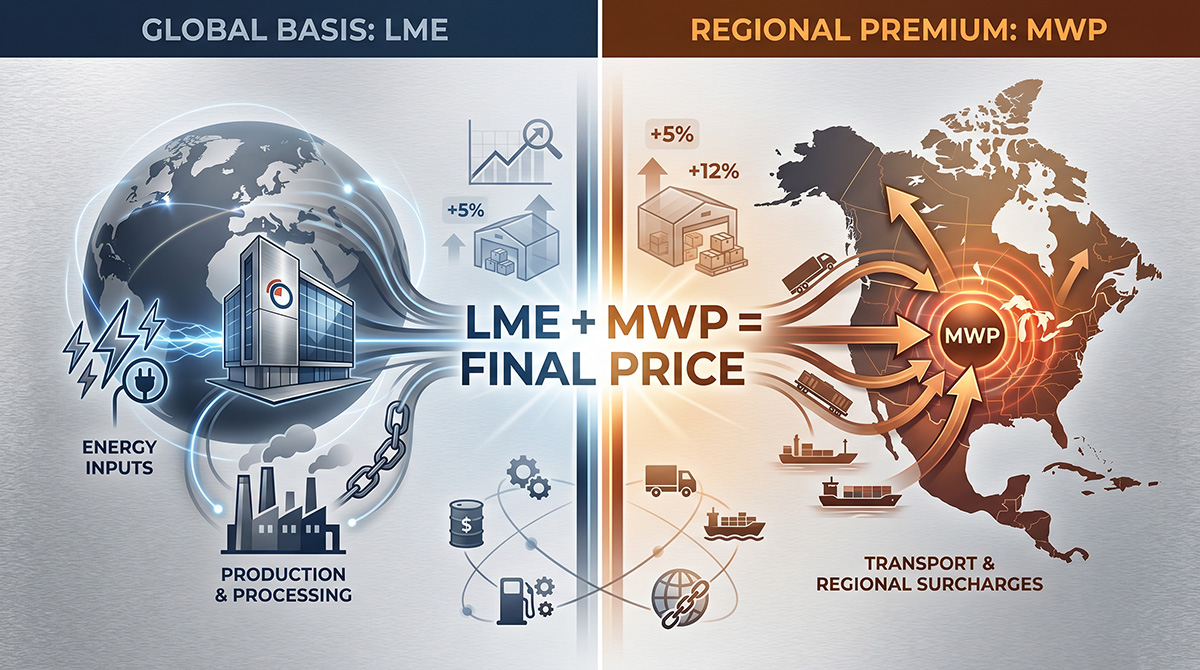
Unlock LME and MWP: The Forces Behind Aluminum Pricing
If you’re a purchasing agent, R&D professional, or business owner trying to understand why your aluminum foil pricing keeps climbing—or simply trying to decode a supplier quote—you’re not alone. The aluminum market in 2026 is more complex than ever, driven by a combination of global benchmarks, regional surcharges, and supply chain realities that make the final price feel like an unsolvable equation.
The truth is, aluminum pricing isn’t just one number. It’s a formula that combines the London Metal Exchange (LME) base price, the Midwest Premium (MWP), and several other factors specific to your needs. Understanding these components isn’t just academic—it’s essential for making informed sourcing decisions, especially in a market where the Midwest Premium has surged to record highs due to tariffs and domestic supply constraints.
Whether you’re sourcing material for flexible packaging, battery applications, or food wrap, this guide will demystify the pricing structure and help you navigate the current market landscape.
Understanding the London Metal Exchange (LME): The Global Baseline
The London Metal Exchange serves as the global benchmark for primary aluminum pricing, specifically for P1020 grade aluminum ingot. Think of the LME as the “sticker price” for aluminum at its most basic, raw form—before any regional factors, transportation costs, or fabrication comes into play.
What Drives LME Prices?
Several interconnected factors influence daily LME pricing:
Energy Costs: Aluminum is often called “solid electricity” because production is incredibly energy-intensive. It takes approximately 15,000 kilowatt-hours to produce one ton of primary aluminum. When global energy prices spike—as they have in recent years—LME prices follow closely behind.
Global Supply and Demand: Major producing regions like China, Russia, and the Middle East directly impact worldwide availability. Production cuts, new smelter capacity, or trade restrictions can swing prices significantly within weeks.
Inventory Levels: The LME tracks physical aluminum stored in its worldwide network of warehouses. When inventories drop below critical thresholds, prices typically rise as buyers compete for limited material.
Geopolitical Events: Trade disputes, sanctions, and political instability in major producing nations create uncertainty that often translates to price volatility.
For 2026, the LME has remained elevated due to persistent energy costs and ongoing geopolitical tensions affecting major aluminum-producing regions. While the LME provides the foundation for global pricing, it’s just the first component of what you’ll actually pay.
Demystifying the Midwest Premium (MWP): More Than Just Shipping
This is where many buyers get confused. The Midwest Premium isn’t simply a freight charge or a minor add-on—it’s a critical regional assessment that reflects the real cost of getting aluminum to the US Midwest market, which serves as the benchmark for North American pricing.
Why the MWP Exists: The Supply Gap Reality
The United States faces a fundamental aluminum supply challenge. Annual demand sits at approximately 12 million tons, while domestic production capacity is only about 4.3 million tons. This 7.7-million-ton gap means the US market relies heavily on imports to meet demand.

A significant domestic supply gap in the United States drives the Midwest Premium, as the market must rely on imports to meet the 12-million-ton annual demand.
Current Market Context: Record-High MWP in 2026
As of 2026, the Midwest Premium has reached approximately $0.85 per pound—a historic high driven primarily by two factors:
Tariff Impact: The implementation of 50% tariffs on imported aluminum in 2025 fundamentally changed the cost structure for bringing metal into the US market. These tariffs were designed to protect domestic production, but with limited domestic capacity, they’ve primarily resulted in higher costs for buyers.
Transportation and Logistics: Beyond tariffs, physical logistics costs—including ocean freight, port handling, inland transportation, and warehousing—all factor into the premium. Supply chain disruptions continue to add unpredictability and cost to the equation.
Myth-Busting: MWP as Market Assessment
It’s crucial to understand that the MWP isn’t arbitrary. Independent price assessors like plates (S&P Global) survey actual market transactions to determine the premium. This means the MWP reflects what buyers are actually willing to pay to secure aluminum in the regional market—it’s a real-time indicator of supply tightness or availability.
For those sourcing aluminum products in 2026, the elevated MWP represents a structural reality rather than a temporary spike. Until domestic production capacity increases significantly or tariff policies change, the premium will likely remain a substantial portion of your total cost.
The Complete “All-In” Pricing Formula
Now that we’ve established the two major market-driven components, let’s break down how your actual aluminum foil price is calculated:

The ‘All-In’ pricing structure for aluminum foil combines global market rates with regional surcharges and specific fabrication costs to reach a final delivered price.
LME ($/lb) + Midwest Premium ($/lb) + Fabrication/Conversion ($/lb) + Freight = Final Delivered Price
Component 3: Fabrication and Conversion Costs
This is where the raw aluminum ingot becomes the specific product you need. For aluminum foil buyers, conversion costs include:
Rolling to Gauge: Transforming thick aluminum into thin foil requires multiple rolling passes. Thinner gauges (measured in microns or thousandths of an inch) require more processing and typically cost more per pound.
Alloy Selection: Different applications require specific alloy series. The 1000 series offers excellent formability and corrosion resistance for basic packaging. The 3000 series adds strength for more demanding applications. The 8000 series provides specialized properties for specific end uses. Each alloy type carries different processing costs.
Width and Precision: Wider foils or tighter tolerance specifications add to conversion costs. Custom widths often require dedicated slitting operations.
Surface Treatment: Many applications require additional processing like annealing (heat treatment to improve workability), cleaning, or surface preparation for subsequent coating operations.
Value-Added Services: Operations like laminating, applying pressure-sensitive adhesives, or graphic printing all contribute to the final cost but also deliver the specific performance characteristics your application demands.
Component 4: Freight and Logistics
The final piece depends on your location, order size, and delivery requirements. Larger orders typically benefit from better freight rates, while rush deliveries or special handling add premium charges.
The Aluminum Foil Converter’s Critical Role
Understanding who processes your material is just as important as understanding the raw material cost. An aluminum foil converter serves as the bridge between primary aluminum producers and end users, providing the specialized processing and value-added services that transform commodity metal into application-ready products.
What Converters Do
Precision Processing: Converting aluminum from mill-finished coil to precise gauge foil requires specialized equipment and expertise. Slitting, sheeting, and rewinding operations ensure you receive material in exactly the format you need.
Quality Control: Reputable converters maintain strict quality standards, offering certifications and compliance documentation that trace material back to the original mill.
Technical Support: Experienced converters provide application guidance, helping you select the right alloy, gauge, and surface treatment for your specific needs.
Inventory Management: By maintaining stock positions, converters can shield customers from daily LME volatility and provide faster delivery than ordering directly from a primary mill.
Why Sourcing Strategy Matters: Mills vs. Distributors
The current market dynamics have created a critical decision point for many aluminum buyers. Understanding the trade-offs between sourcing directly from mills versus working with domestic distributors can significantly impact both your costs and supply chain reliability.
The Primary Mill Challenge
Large aluminum mills typically operate with high minimum order quantities (MOQs)—often 20,000 pounds or more. They also work with extended lead times, sometimes 8-16 weeks for custom specifications. For high-volume industrial buyers, this model works well. But for smaller manufacturers, R&D teams, or businesses with variable demand, these requirements create significant barriers.
The Domestic Distributor Advantage
Working with a specialized aluminum distributor offers several strategic benefits in the current environment:
Lower MOQs: Access to smaller quantities enables prototyping, testing, and production flexibility without tying up capital in excess inventory.
Price Risk Mitigation: Distributors who maintain inventory absorb some of the daily LME fluctuation risk. While you’ll pay a margin for this service, you gain predictability in your cost structure.
Faster Turnaround: Stock positions mean delivery in days rather than months, enabling more responsive production planning.
Domestic Reliability: With ongoing supply chain uncertainties, having a domestic source reduces exposure to international shipping delays, port congestion, and customs complications.

Choosing the right sourcing partner involves balancing the scale of a primary mill against the flexibility and risk-mitigation benefits of a domestic distributor.
Practical Guidance for Today’s Market
Given the elevated pricing environment and structural supply constraints, here are strategic considerations for purchasing decisions in 2026:
Watch Trends, Not Just Absolute Prices: Waiting for a return to historical lows may mean missing production windows. Focus instead on understanding the trend and locking in pricing when indicators suggest a local peak.
Build Distributor Relationships: Having qualified alternative sources provides leverage and supply security. The premium you pay for distributor services often pays for itself in reduced risk and improved responsiveness.
Consider Total Cost of Ownership: The lowest per-pound price isn’t always the best value. Factor in inventory carrying costs, obsolescence risk, and the opportunity cost of capital tied up in large minimum orders.
Communicate Requirements Clearly: Whether you need material for HVAC applications, food and beverage packaging, or electronic components, providing detailed specifications upfront enables more accurate quotes and reduces the risk of ordering incorrect material.
Plan for Continued Volatility: The structural factors driving current pricing—the domestic supply gap, elevated energy costs, and tariff policies—are not likely to resolve quickly. Build supply chain resilience by diversifying sources and maintaining strategic buffer stock where practical.
Looking Forward: Managing Your Aluminum Sourcing
The aluminum market’s complexity won’t disappear anytime soon. The interplay between global LME pricing, regional premiums, and specific conversion costs creates a dynamic pricing environment that requires active management rather than passive acceptance.
For purchasing professionals and business owners, understanding the components behind your aluminum foil pricing enables more strategic decisions. Whether you’re sourcing for automotive applications, medical and pharmaceutical uses, or building and construction projects, the fundamental pricing equation remains the same—but how you approach sourcing can make a significant difference in both cost and supply reliability.
The current market rewards buyers who understand not just what they’re paying, but why—and who build relationships with supply partners that can translate complex global market dynamics into reliable, application-specific solutions. By understanding the LME, the Midwest Premium, and the full value chain from ingot to finished foil, you’re better positioned to navigate today’s challenging aluminum market and make informed decisions that support your business objectives.
For custom quotes and to discuss your specific aluminum foil requirements, contact our team to learn how we can support your sourcing needs with domestic reliability and flexible order quantities.