
Triple Aught Meaning: Understanding Thickness Terminology
What does triple aught mean?
In the aluminum foil industry, “triple aught” refers to a thickness of 0.000x inches, where “aught” (derived from “naught,” meaning zero) represents the number of zeros immediately following the decimal point. For example, “triple aught three” means the material is exactly 0.0003 inches thick.
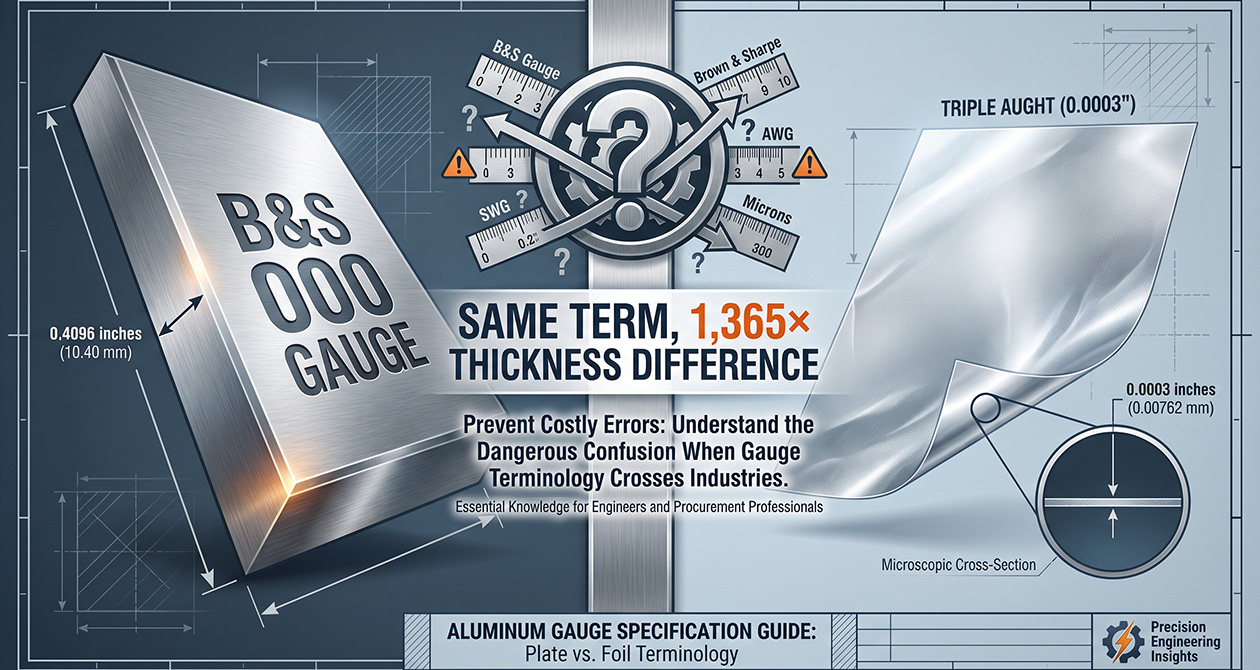
If you’ve been sourcing aluminum foil and encountered the term “triple aught” on a specification sheet or in a conversation with a mill representative, you’re not alone in being confused. This archaic but persistent terminology creates constant headaches for purchasing agents and engineers who suddenly realize their standard gauge charts don’t match what suppliers are telling them. The confusion is understandable: the same “000” designation that means nearly half an inch thick on a Brown & Sharpe gauge chart refers to material thinner than a human hair in the foil world.
Let’s decode this industry jargon so you can confidently navigate specifications, compare suppliers, and order exactly what you need.

Understanding the ‘Aught’ system is as simple as counting zeros. In the foil industry, ‘triple’ refers specifically to the three decimal places preceding the final digit.
Why the Confusion? Gauge Systems vs. Decimal Shorthand
The root of the confusion lies in conflicting numbering systems. Most engineers are familiar with the Brown & Sharpe (B&S) gauge system, also known as the American Wire Gauge (AWG), which was originally developed for wire and later applied to sheet metal. In this system, 000 gauge (triple aught) aluminum plate measures 0.4096 inches thick—nearly half an inch.
But the aluminum foil industry operates differently. When foil converters and mill workers say “triple aught,” they’re not referencing the B&S gauge chart at all. Instead, they’re using a verbal shorthand for decimal placement that emerged from decades of shop floor communication. Think of it as counting zeros after the decimal point:
- Triple aught = 0.000x” (three zeros)
- Double aught = 0.00x” (two zeros)
- Single aught = 0.0x” (one zero)
This isn’t an official standard you’ll find in ASTM specifications—it’s industry vernacular that persists because it’s quick, intuitive, and has been passed down through generations of mill operators and foil processors. The problem arises when someone trained on standard gauge charts encounters this terminology for the first time without context.

Don’t let the terminology mislead you: standard gauge charts and foil industry jargon use the same numbers to describe vastly different thicknesses.
The Aught Decoder: Converting Terminology to Actual Thickness
Here’s the practical translation guide you need when working with aluminum foil specifications:
| Industry Term | Decimal (Inches) | Micro-Inches | Microns (µm) | Common Application |
|---|---|---|---|---|
| Triple Aught Three | 0.00030″ | 300 | ~7.6 µm | Ultra-thin converter foil, capacitor applications |
| Triple Aught Five | 0.00050″ | 500 | ~12.7 µm | Standard thin foil, flexible packaging |
| Double Aught Seven | 0.0070″ | 7,000 | ~177.8 µm | Heavy-duty foil, container stock |
| Single Aught (or just “Aught”) | 0.010″ | 10,000 | ~254 µm | Transitional thickness between foil and sheet |
The strategic insight here is simple: “aught” is effectively a zero counter. When someone says “triple aught five,” they’re telling you there are three zeros after the decimal, followed by a five: 0.0005 inches.
This system makes perfect sense once you understand it, but it creates real problems during procurement. A buyer requesting “000 gauge material” could receive a quote for 0.4096-inch plate when they actually need 0.0003-inch foil—a difference of more than 1,300 times the intended thickness.
Triple Aught vs. Double Aught: Understanding the Difference
The distinction between triple aught and double aught foil isn’t just academic—it determines manufacturing feasibility, material properties, and end-use applications.
Triple aught foil (0.0002″ to 0.0005″ range) represents some of the thinnest aluminum material commercially available. Creating foil this thin requires numerous passes through rolling mills, with each pass reducing thickness while work-hardening the material. The technical challenges increase exponentially as you get thinner:
- Pinhole defects become more common and critical to monitor
- Tensile strength decreases, requiring careful handling during slitting and converting
- Surface quality becomes paramount, as any imperfection is magnified
- Production time increases significantly, impacting cost
Triple aught foil is the material of choice for applications where weight, conformability, or barrier properties are critical. You’ll find it in pharmaceutical packaging that needs to block moisture and oxygen, in specialized electronics applications like capacitors, and in high-end food packaging where a thin yet reliable barrier is essential.
Double aught foil (0.005″ to 0.009″ range) represents a more robust material that’s easier to manufacture and handle. This thickness range is common for:
- Heavy-duty household foil wraps
- Food service applications requiring durability
- Industrial heat shields and insulation
- HVAC ducting and fins
The practical difference in handling is substantial. Triple aught foil tears easily and requires specialized tension control during processing. Double aught material can withstand more aggressive converting processes and typical warehouse handling without compromising integrity.

From ultra-thin converter foils to heavy-duty container stock, the ‘aught’ system helps engineers quickly categorize material thickness for specific applications.
Selecting the Right Thickness for Your Application
Understanding the terminology is only the first step. Choosing between triple aught and thicker gauges requires considering several technical factors:
Barrier Requirements: Triple aught foil provides excellent moisture and oxygen barriers when properly laminated or coated. For applications requiring hermetic seals—like blister packaging for pharmaceuticals—the thinner material often performs as well as heavier gauges while reducing material costs.
Conformability: If your application requires the foil to wrap around irregular shapes or undergo complex forming operations, triple aught material offers superior dead-fold characteristics. This is why ultra-thin foils dominate in applications like cheese wrap and confectionery packaging.
Structural Integrity: For applications where the foil must support weight or resist puncture—like container lids or tool wraps—double aught or heavier gauges provide necessary strength.
Processing Requirements: If you plan to laminate, coat, or print on the foil, material thickness affects processing parameters. Triple aught foil requires more careful tension control and slower line speeds during converting operations.
Cost Considerations: While triple aught foil costs more per pound due to manufacturing complexity, you use significantly less material per square foot. The total cost equation depends on your specific application, volume requirements, and whether material savings offset the higher unit price.
Sourcing Triple Aught Foil: The Minimum Order Challenge
One of the most frustrating aspects of sourcing triple aught aluminum foil is that major mills typically focus on high-volume orders—often 10,000 pounds or more. When you need smaller quantities for R&D, prototyping, or specialized production runs, you quickly discover that most mills aren’t interested in your business.
This is where specialized distributors and converters become invaluable. Companies that maintain inventory and offer toll processing services can provide triple aught foil in smaller, more practical quantities. They bridge the gap between the large mill’s production realities and your actual material needs.
When sourcing triple aught material, be sure to specify:
- Exact decimal thickness (not just “triple aught”)
- Alloy designation (1235, 8011, 8079, etc.)
- Temper (O, H22, H24, etc.)
- Width and length requirements
- Surface finish (bright, semi-bright, or standard)
- Pinhole specifications if critical for your application
- Required certifications for regulated industries
The more precise your specification, the fewer surprises you’ll encounter during qualification and production.
Navigating Industry Conversations with Confidence
Now that you understand the “aught” system, you can confidently communicate with suppliers, interpret specification sheets, and avoid costly ordering mistakes. When a mill representative mentions “triple aught five,” you’ll immediately know they’re discussing 0.0005-inch material—not some obscure gauge designation requiring translation.
Remember that this terminology, while informal, has deep roots in the aluminum industry. Many experienced mill workers and converters grew up using this shorthand and find it more intuitive than decimal notation. Rather than trying to eliminate the terminology, embrace it as part of the industry’s technical language.
The key is ensuring everyone is aligned on actual specifications. Always confirm decimal thickness in writing, even when verbal conversations use “aught” terminology. A simple confirmation like “Just to confirm, you’re quoting 0.0005-inch material, correct?” prevents misunderstandings before they become expensive mistakes.
Getting the Foil You Need
Understanding what “triple aught” means transforms you from someone confused by industry jargon to someone who speaks the language of aluminum foil processing. This knowledge empowers you to evaluate suppliers more effectively, specify materials precisely, and ensure your procurement process delivers exactly what your application requires.
Whether you need ultra-thin triple aught converter foil for specialized packaging or more robust double aught material for industrial applications, All Foils specializes in sourcing and converting these precise thicknesses that large mills often overlook for smaller production runs. Our technical team understands both the formal specifications and the shop-floor terminology that can make or break your material sourcing.
Need a domestic source for triple aught aluminum foil with flexible minimum orders? Contact our engineering team to discuss your specific requirements, or request a quote for your next project. We’ll help you translate your application needs into the right material specification—whether you call it triple aught, 0.0005 inches, or 12.7 microns.